
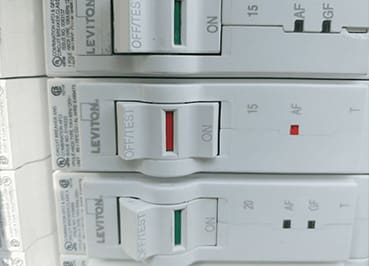
Most homeowners have heard of GFCI outlets, but arc fault protection is far less understood, even though it plays just as critical a role in preventing house fires. If you’ve ever wondered what an AFCI breaker actually does, or whether your Baton Rouge home has adequate protection, here’s what you need to know.
What Is an Arc Fault Circuit Interrupter (AFCI)?
An Arc Fault Circuit Interrupter, or AFCI, is a safety device designed to detect dangerous electrical arcing before it can start a fire. Arcing occurs when electrical current jumps across a gap in a damaged or loose connection, generating intense heat in the process. Unlike a standard circuit breaker, which responds to overloads and short circuits, an AFCI is engineered specifically to recognize the electrical signature of arcing and shut off power before that heat has a chance to ignite nearby insulation, wood framing, or other combustible materials.
Working in homes throughout Baton Rouge, from older properties near the Garden District to newer construction out toward Jefferson Highway and the Perkins Road corridor, we routinely see wiring systems that were never built with this kind of protection in mind. Homes constructed before AFCI requirements became standard in the National Electrical Code often have little defense against this specific fire risk.
Why Arc Fault Protection Matters in Baton Rouge Homes
Louisiana’s climate places real stress on residential electrical systems. Humidity, heat, and the seasonal storms that roll in off the Gulf all contribute to wear on wiring, connections, and outlets over time. Combine that with the age of housing stock across much of Baton Rouge, and the conditions for arc faults, loose connections, deteriorating insulation, rodent damage in attics and crawlspaces, and worn outlets, are common.
Based on what we see in Baton Rouge properties, arcing faults are frequently the hidden cause behind electrical fires that seem to start without explanation. A connection can arc intermittently for months before it generates enough heat to ignite surrounding material, which is exactly why AFCI protection is designed to catch the problem long before it becomes visible.
How AFCIs Differ from Standard Breakers and GFCIs
It’s a common misconception that a standard breaker or a GFCI outlet already provides this protection. They don’t, at least not in the way an AFCI does.
A standard circuit breaker is designed to trip when a circuit draws more current than it’s rated for, protecting against overloads and dead short circuits. A GFCI is designed to protect people from electric shock by detecting imbalances in current, most useful in areas where water and electricity are close together, like kitchens and bathrooms. An AFCI serves a different purpose entirely. It’s listening for the specific, irregular electrical pattern that arcing produces, a pattern that can occur even on a circuit that isn’t overloaded and isn’t in a wet location.
Because these three devices protect against different hazards, many modern electrical panels are now designed to incorporate all three types of protection in the areas of the home where each is required.
Where AFCI Protection Is Required
The National Electrical Code has expanded AFCI requirements over successive updates, and most living spaces in a home now fall under this requirement, including bedrooms, living rooms, dens, hallways, and similar areas. If your Baton Rouge home was built or last rewired before these code updates took effect, there’s a good chance your electrical panel doesn’t yet include this protection where it’s now required.
A professional electrical safety inspection is the most reliable way to determine which circuits in your home currently have AFCI protection and which ones don’t.
Signs Your Home May Need AFCI Protection
A few warning signs suggest a home may be at greater risk from arc faults and could benefit from updated protection:
- An aging or original electrical panel. Panels installed decades ago were not designed to accommodate AFCI breakers and often need to be evaluated as part of any upgrade.
- Frequent, unexplained breaker trips. A breaker that trips without a clear cause may be responding to an arcing condition rather than a simple overload.
- Flickering lights not tied to appliance use. While flickering has several possible causes, intermittent arcing is one of them.
- Visible wear on outlets or switches. Discoloration, warmth, or a faint burning smell near an outlet can indicate a connection that’s already arcing.
Any of these signs warrants a call to a licensed electrician rather than a wait-and-see approach.
Upgrading Your Panel for AFCI Protection
For many older homes in Baton Rouge, adding comprehensive AFCI protection means more than just swapping a breaker. It often requires a broader look at the panel itself. An electrical panel upgrade allows a home to accommodate modern AFCI and dual-function breakers throughout, while also addressing capacity limitations that older panels weren’t built to handle.
In cases where a full panel upgrade isn’t immediately necessary, circuit breaker installation can add AFCI protection to specific circuits identified as higher risk during an inspection.
For homes with wiring that’s significantly deteriorated or outdated, electrical rewiring may ultimately be the safest and most cost-effective path forward, since it addresses the root condition rather than just the symptoms.
Protecting Your Baton Rouge Home for the Long Term
Arc fault protection isn’t something most homeowners think about until it’s explained to them, but it addresses a real and largely invisible fire risk that’s especially relevant in a city with as much older housing stock as Baton Rouge. The safest way to know where your home stands is a professional evaluation of your panel and wiring, not guesswork.
If you’re unsure whether your home has adequate arc fault protection, contact our team today and let us walk you through what your electrical system needs to keep your family safe.